
Salt (sodium chloride) is one of the most basic and vital components of bread formulation. The role of salt goes beyond adding a pleasant taste to the final product; This substance is considered a powerful chemical controller in the process of fermentation and dough structuring.
In short, salt has three main functions in baking:
- Yeast activity control: Salt prevents excessive and rapid growth of yeast. By reducing the fermentation speed, enough time is provided for the production of carbon dioxide gas and it also prevents the excessive production of lactic acid that can make the dough taste spicy.
- Strengthening the structure of gluten: Salt helps the structure of the gluten protein network to become stronger and more flexible. This allows the dough to hold the gases produced during fermentation more effectively, and as a result, the volume of the bread increases.
- Improving the color and crust of the bread: Salt plays a role in the process of caramelizing sugars during baking and helps to create a golden brown crust.
According to the fundamental importance of salt, choosing the right type is essential for professional bakeries that seek quality stability.
Iodine challenge in bakery
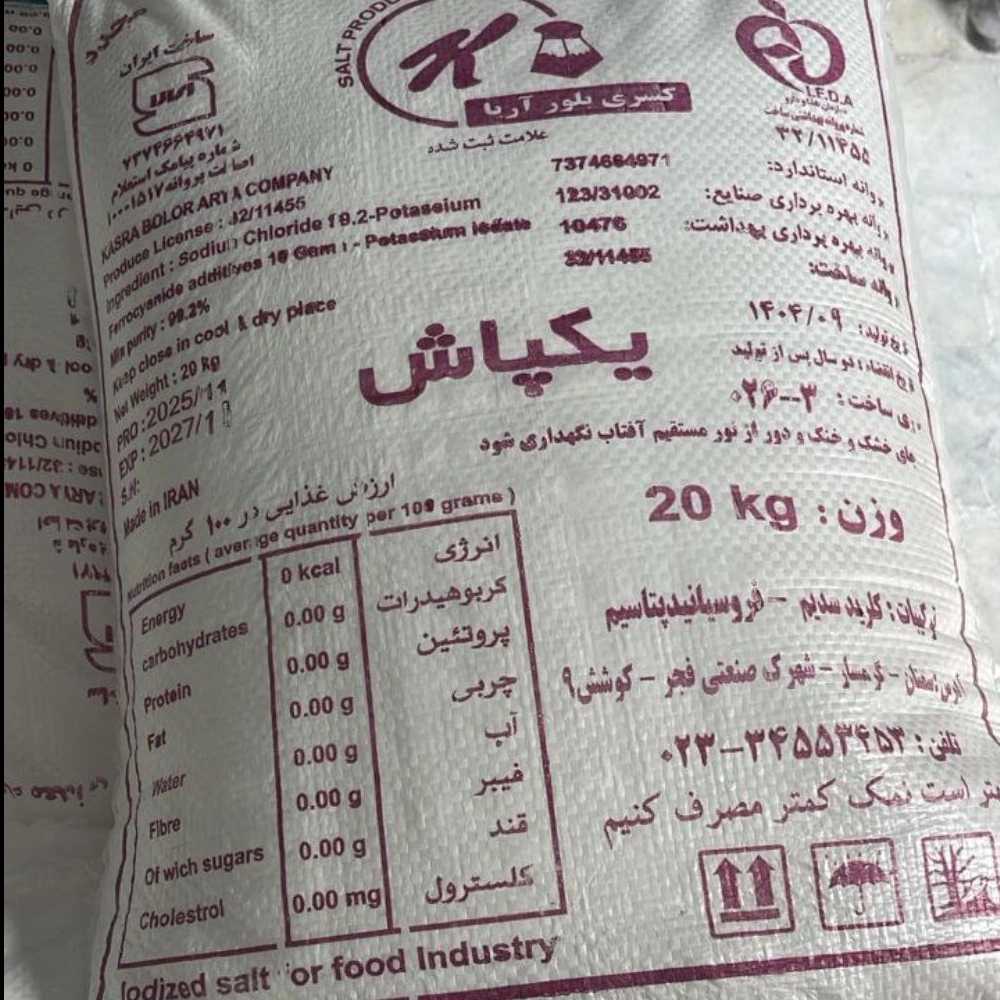
In many regions of the world, table salt is enriched with iodine (usually in the form of potassium iodate $\text{KIO}_3$) in order to prevent disorders caused by iodine deficiency. Although this is a very important public health measure, the use of iodized salt in specialized bakery processes can present challenges.
Potassium iodate, as a strong oxidizing agent, can be activated in moist environments and under special conditions that exist in bread dough. This substance can interact with organic compounds in the dough, especially with enzymes and proteins that are essential for fermentation and structure development.
Possible interactions of potassium iodate in dough:
- Interaction with yeast: As an oxidizer, potassium iodate can directly affect the metabolic activity of yeast, leading to suppression or reduction of its activity. This decrease in activity means that the fermentation process is slow or incomplete.
- Damage to the gluten structure: Iodates can interfere with the disulfide bonds in the gliadin and glutenin proteins that make up the gluten network. This interference can lead to a weakening of the dough structure, a decrease in the ability of the dough to retain gas, and ultimately a decrease in the final volume of the bread. Unfavorable results: Breads prepared with iodized salt may have a smaller volume, denser texture, and a poorer crust than breads prepared with pure salt. Professional bakers seek reproducibility (consistency), and the presence of an unpredictable oxidizing agent such as iodine compromises this stability.
Advantages of non-iodized salt (pure salt) for professional bakers
Non-iodized salts, which are usually pure sodium chloride and do not contain iodized additives, give the baker more control and the salt's role is limited to an osmotic regulator and gluten enhancer.
The key benefits of using pure salt are:
A) Achieving uniform and optimal texture and volume in bread
By removing potassium iodate, the dough structure is less exposed to oxidative stress. This ensures that the gluten network develops in the best possible way and maintains the necessary stability during fermentation and baking. The result, breads with:
b) More precise control over fermentation time
In industrial bakeries, the timing of processes (such as dough ripening) is very critical. Pure salt allows the baker to control the rate of fermentation simply by adjusting the amount of yeast, temperature and time. The absence of potassium iodate as an unwanted variable allows for a more accurate prediction of the time required for primary and secondary fermentation.
c) Maintaining the natural color of the dough and preventing color change
Potassium iodate, in the presence of some compounds in flour, can cause unwanted oxidation reactions, which sometimes lead to a change in the color of the dough or baked bread (darkening or staining). Pure salt minimizes these reactions and helps maintain the natural and expected color of the product.
Conclusion and appeal
In the world of modern and traditional bakeries, raw materials must be selected in such a way as to guarantee the highest level of quality and reproducibility. Although iodized salt is essential for general household use, non-iodized salt is a strategic choice for professional bakers.